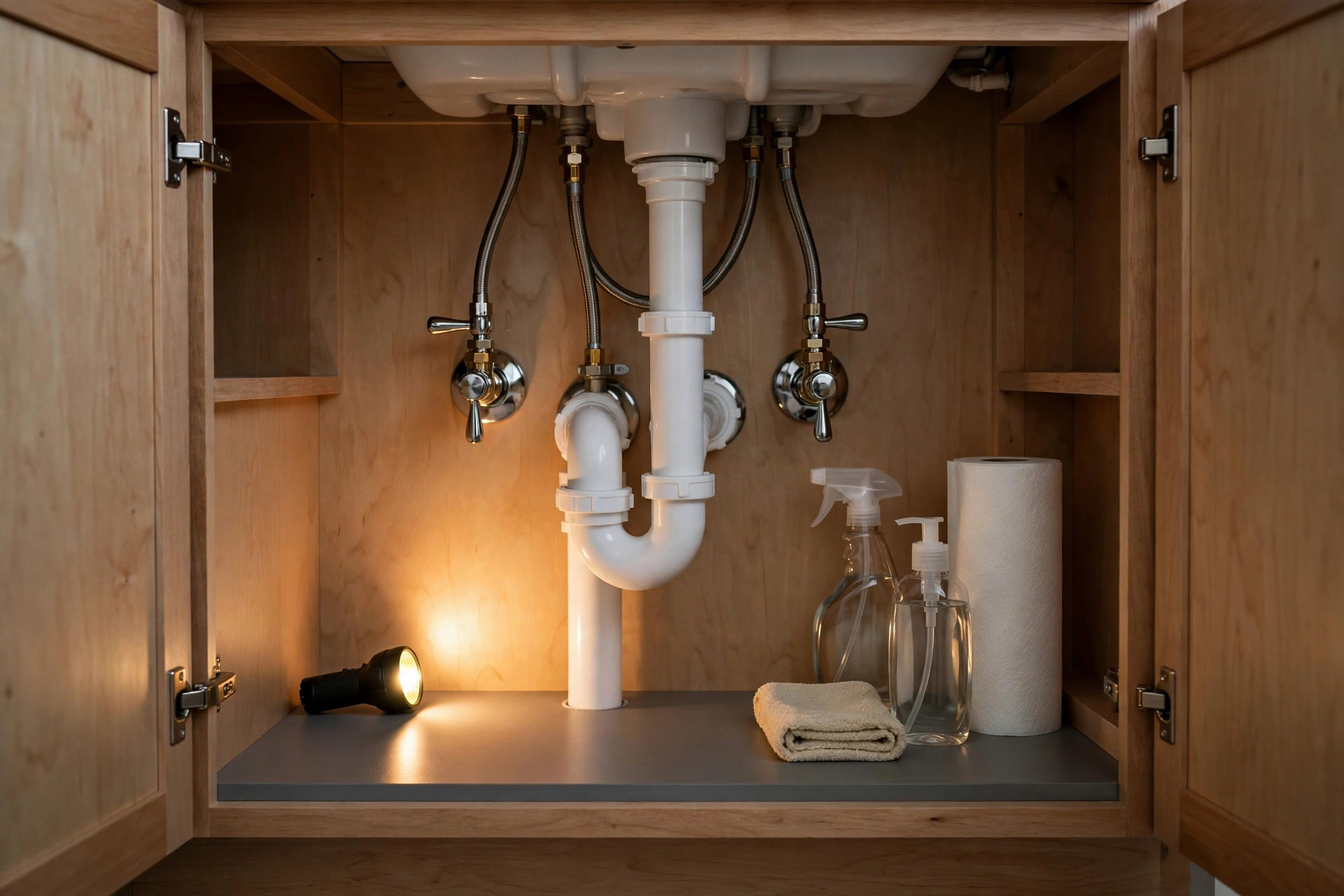
I’m not a plumber. But once a year, I spend about an hour walking through my house with a flashlight, and that hour has caught two problems that would have cost me thousands if they’d kept going quietly. Almost everything here is look-and-feel — no tools, no expertise needed.
Under every sink: the five-minute look that matters most
Open the cabinet under each sink and look with a flashlight. You’re checking for damp spots, water stains, musty smells, swollen particleboard, and white or green crusty buildup on supply lines and shutoff valves. Run the faucet and watch the drain connections while water flows — slow drips often only show up under pressure.
Feel the flexible supply hoses. If they’re brittle, corroded, or older than 5–10 years, replace them with braided stainless steel lines. Burst supply hoses are one of the top causes of home flooding. I replaced all of ours after finding one under the guest bathroom sink bulging in a way that made me nervous just looking at it.
While you’re down there, turn each shutoff valve off and back on. Valves that sit untouched for years seize up — and a seized valve is useless in an emergency.
Around every toilet: the food-coloring trick
Check the base where the toilet meets the floor. Any rocking, softness in the flooring, or water staining means the wax ring seal is failing — a cheap part, but a leak that will rot the subfloor if ignored. Flush and watch the supply line and tank bolts for drips.
Then do the food-coloring test for silent leaks: a few drops of food coloring in the tank, wait 20 minutes without flushing. If color appears in the bowl, the flapper is leaking — a $10 part that can waste thousands of gallons a year, and you’d never know, because it makes no sound.
I did this on our upstairs toilet on a whim, and the bowl turned faintly blue. Five minutes to swap the flapper, and our water bill dropped noticeably the next month. I do this test every year now like a ritual, because it feels like catching the house in a lie.
The water heater: thirty seconds in the basement
Look for rust streaks, moisture at the base, and corrosion on the top fittings. Note the manufacture date — tanks over 10 years old deserve a replacement budget. Lift the temperature-pressure relief valve lever briefly to confirm water flows and stops. If you’re comfortable, drain a few gallons from the drain valve to flush sediment.
I do this every time I’m in the basement for anything else. It’s a habit now, like checking the rearview mirror. Thirty seconds, and I’d spot trouble months before it became an emergency.
Washing machine hoses: the ones everyone forgets
Pull the washer out enough to see the hoses. Rubber hoses older than five years are living on borrowed time — replace them with braided stainless steel, which lasts far longer. Check for bulges, cracks, and dampness at the connections. While you’re back there, make sure the drain hose is secured and not jammed too far down the standpipe.
These hoses scared me into action more than anything else on this list. A burst washing machine hose can dump gallons per minute while you’re at work. Ours were the original rubber ones, eight years old — I replaced them the same weekend I checked.
Outdoor spigots: before the first freeze
Before the first freeze — and again in spring — check exterior faucets for drips and make sure they shut off fully. A spigot that won’t fully close can freeze and burst the pipe inside the wall. Disconnect all hoses for winter: a connected hose traps water in the spigot. I set a phone reminder every October; the one year I forgot, I spent a nervous March watching a dripping spigot. The wondering wasn’t worth it.
Sump pump: the two-minute test (if you have one)
Pour a bucket of water into the sump pit until the float rises and the pump kicks on. Confirm it pumps the water out and shuts off. A sump pump that fails during a spring storm is a basement flood — this two-minute test once a year is cheap insurance. If you have a battery backup, check its charge and age. I do mine every April, right before the rainy season.
Main shutoff and water pressure: the drill everyone should run
Make sure everyone in the household knows where the main water shutoff is — and that it actually turns. I made my teenager practice this once. In an emergency, the first step is always stopping the water, and nobody should be Googling “where is the main shutoff” while water pours through the ceiling.
If you have a pressure gauge — they screw onto a hose bib and cost under $15 — check your home’s water pressure. It should read 40 to 60 psi. Above 80 psi stresses pipes, appliance hoses, and water heaters; you may need a pressure-reducing valve. Ours read 72 when I first checked. Not emergency territory, but high enough that I keep an eye on it.
Drains: listen to what the house tells you
Run each faucet and shower and watch the drain. Slow drainage in one fixture is usually a local clog — hair, soap — that you can clear with a drain snake or enzyme cleaner. Skip the harsh chemical drain openers; they can damage pipes.
Slow drainage in multiple fixtures at once is a different story — that can signal a main-line issue worth a professional camera inspection, especially in homes with older clay or cast-iron sewer lines and large trees nearby. Roots love sewer lines.
Write it down: the log that turns worry into decisions
Keep a simple log — a note on your phone works — with the date of this check and anything you found, plus photos of anything questionable. Note the age of your water heater and washing machine hoses in the same log so replacement timing never sneaks up on you.
The small toolkit worth owning
You don’t need a plumber’s truck. But a small kit handles 90% of minor issues: a plunger (both a cup plunger for sinks and a flange plunger for toilets — they’re different tools, and I owned the wrong one for two years), an adjustable wrench, plumber’s tape for threaded connections, a drain snake (the $15 hand-crank kind), and a bucket and old towels.
When to call a professional (no shame in it)
Call a plumber for: anything involving the main sewer line, gas lines (water heaters, furnaces — never DIY gas, ever), persistent leaks you can’t source, water pressure problems affecting the whole house, and any project requiring a permit.
My rule: if you have to ask “is this safe for me to do,” the answer is usually to call someone. That’s not weakness; that’s judgment.
Also know the difference between a plumber and an emergency: a slow drip can wait for a weekday appointment; water actively spraying, sewage backing up, or no water at all cannot. Know your plumber’s after-hours number before you need it.
The bottom line
Plumbing disasters are rarely sudden. They’re slow leaks that nobody looked at for three years. One hour, once a year, with a flashlight — that’s the entire program, and it’s the cheapest home insurance you’ll ever buy. Mine has already paid for itself twice over.
Leave a Reply