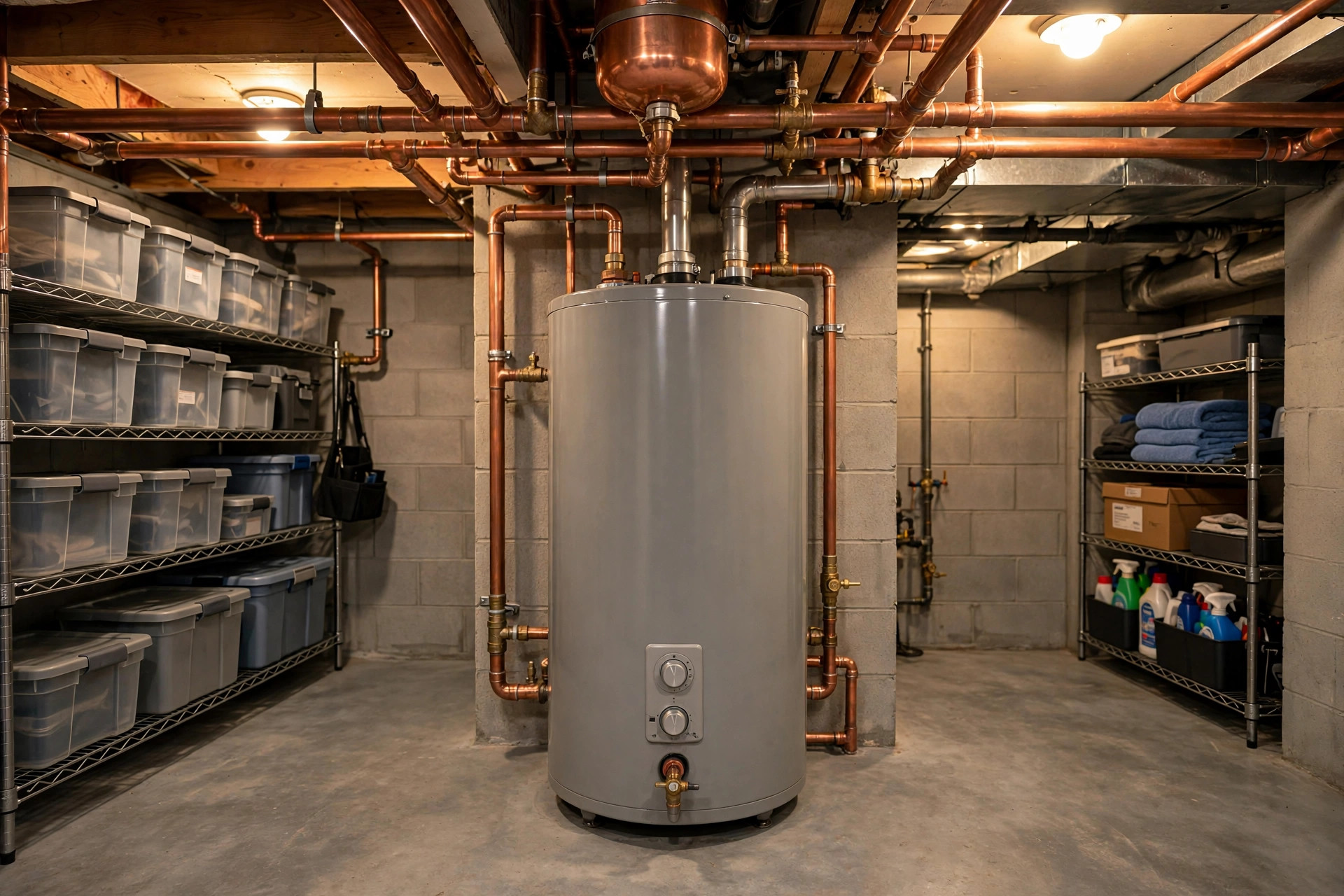
Water heaters are the introverts of the house: they sit in a corner, never ask for attention, then fail catastrophically at 2 a.m. A tank that bursts can dump 40+ gallons of water into your home in minutes. Mine gave me warning signs for weeks, and I almost ignored every one of them because I didn’t know what I was hearing. Here’s what I’ve learned since — so you can replace your heater on your schedule instead of the flood’s.
1. It’s old enough to vote
A conventional tank water heater lasts 8 to 12 years; tankless units last 15 to 20. Find the manufacture date on the rating plate — it’s usually encoded in the serial number, and the manufacturer’s website will decode it.
When I finally decoded mine, it was 11 years old and I felt physically ill — I’d been assuming “maybe five or six.” If your tank is past year 10, start budgeting for replacement even if it seems fine.
2. Rusty hot water (but clear cold water)
If hot water runs rusty but cold water is clear, the inside of the tank is corroding — the glass lining has failed and the steel is rusting. This is not a “wait and see” sign. A rusting tank is a bursting tank in slow motion.
One distinction I had to learn: if both hot and cold run rusty, the problem is more likely your pipes or water supply, not the heater. Hot-only rust is the tank’s confession.
3. It sounds like it’s making popcorn
Sediment builds up on the bottom of every tank. When the burner heats water trapped under that sediment layer, it pops and rumbles — the classic “kettling” sound. Ours started doing this and I genuinely thought something was wrong with the furnace.
Some sediment is normal and flushable. But loud, persistent rumbling in an older tank means heavy buildup that’s overheating the tank bottom and accelerating failure. If yours sounds like a popcorn machine, it’s telling you something.
4. Water pooling around the base
Any moisture around the tank deserves immediate investigation. Condensation happens — but a persistent puddle or damp ring at the base usually means the tank itself is leaking, often from a hairline crack that will grow. Feel the tank’s seams and the drain valve. If the tank wall is the source, replacement is the only fix. A crack doesn’t politely stay a crack.
5. Hot water runs out faster than it used to
If showers that used to be comfortably hot now turn lukewarm halfway through, sediment may be displacing water volume, or a heating element (electric) or burner issue (gas) is reducing capacity. On a young tank this is often repairable; on an old one it’s usually the beginning of the end.
This was my first sign, and I misread it completely — I assumed my teenager was just taking longer showers. Turns out the tank was half full of sediment.
6. Temperature swings for no reason
Water that goes hot-cold-hot points to a failing thermostat, a broken dip tube (which lets cold incoming water mix with hot at the top of the tank), or sediment interfering with the heating elements. A plumber can diagnose it — but on a 10+ year old tank, I’d put the diagnostic fee toward replacement instead.
7. Crusty buildup on the fittings
Check the pipes and valves on top of the heater. Green or white crusty buildup, or rust streaks on the inlet and outlet connections, suggests slow leaks and galvanic corrosion. Corroded fittings can sometimes be replaced — but widespread corrosion on an aging tank is a strong hint the whole unit is deteriorating.
I check this every time I’m in the basement now. Thirty seconds. The crusty green fittings on mine were the second sign I almost missed.
What you can do right now, whatever its age
Flush a few gallons yearly. Attach a hose to the drain valve and run a few gallons into a bucket until the water runs clear. This removes sediment, improves efficiency, and adds years to the tank’s life. One caution from my experience: if that valve has never been opened in a decade, be gentle — or have a plumber do it. Old valves sometimes don’t reseal, and you’ll turn maintenance into an emergency. I had a plumber do mine the first time and watched so I could do it myself after.
Test the temperature-pressure relief valve. Lift its lever briefly — water should flow out the discharge pipe and stop when you release. If nothing comes out, or it keeps dripping, replace the valve. It’s the tank’s critical safety device.
Check the anode rod every few years. This sacrificial metal rod corrodes so your tank doesn’t. When it’s consumed, tank corrosion accelerates fast. Replacing a $30–$60 anode rod can add years to a tank’s life — I had no idea it existed until year nine of owning my house.
Set the temperature to 120°F. Hotter settings waste energy, increase scalding risk, and accelerate sediment buildup and corrosion. Ours was at 140°F when we moved in. Turning it down changed nothing about our showers and everything about our gas bill.
Repair or replace? My rule of thumb
Under 8 years old with an element, thermostat, or valve problem: repair. Over 10 years old with any tank-related symptom — rust, leaks, heavy sediment noise: replace. Between 8 and 10, weigh the repair cost against a new unit, and remember that a planned replacement costs far less than an emergency one plus water damage.
Tank vs. tankless: the question everyone asks
Tank water heaters cost less upfront ($800–$1,500 installed), are simple, and any plumber can service them — but they constantly heat 40–50 gallons, which wastes energy, and they last 8–12 years.
Tankless (on-demand) units cost more ($2,000–$4,500 installed), last 15–20 years, and cut water-heating energy use by roughly 25–35% — but they need sufficient gas line or electrical capacity, require yearly descaling in hard-water areas, and can struggle to supply multiple simultaneous showers in cold climates unless sized correctly.
Tankless pays off best in homes with high hot-water use that plan to stay put for 10+ years; if you might move in five, a quality tank unit is the rational buy. Either way, get three quotes — water heater pricing varies wildly between plumbers. Mine ranged over $1,200 for the same unit.
Making the new one last
Keep the yearly flush habit from day one (sediment is cumulative — starting early matters more than starting late), replace the anode rod at year 4–5 instead of waiting for it to fail, and keep the area around the heater clear so small leaks get noticed instead of hiding behind stored boxes.
And my favorite cheap trick: a $15 water alarm at the base of the heater will shriek at the first sign of moisture. I have one under mine, one under the washing machine, and one under the kitchen sink. Cheapest insurance in the house against the 2 a.m. flood — and after my sediment saga, I sleep better knowing they’re there.
The bottom line
Water heaters rarely die without warning — they whisper first. Check the age, listen for the popcorn rumbling, watch for rust and moisture, and do the yearly flush. Ten minutes of attention now is the difference between a scheduled $1,000 replacement and a surprise $5,000 flood. I learned this the anxious way; you don’t have to.
Leave a Reply