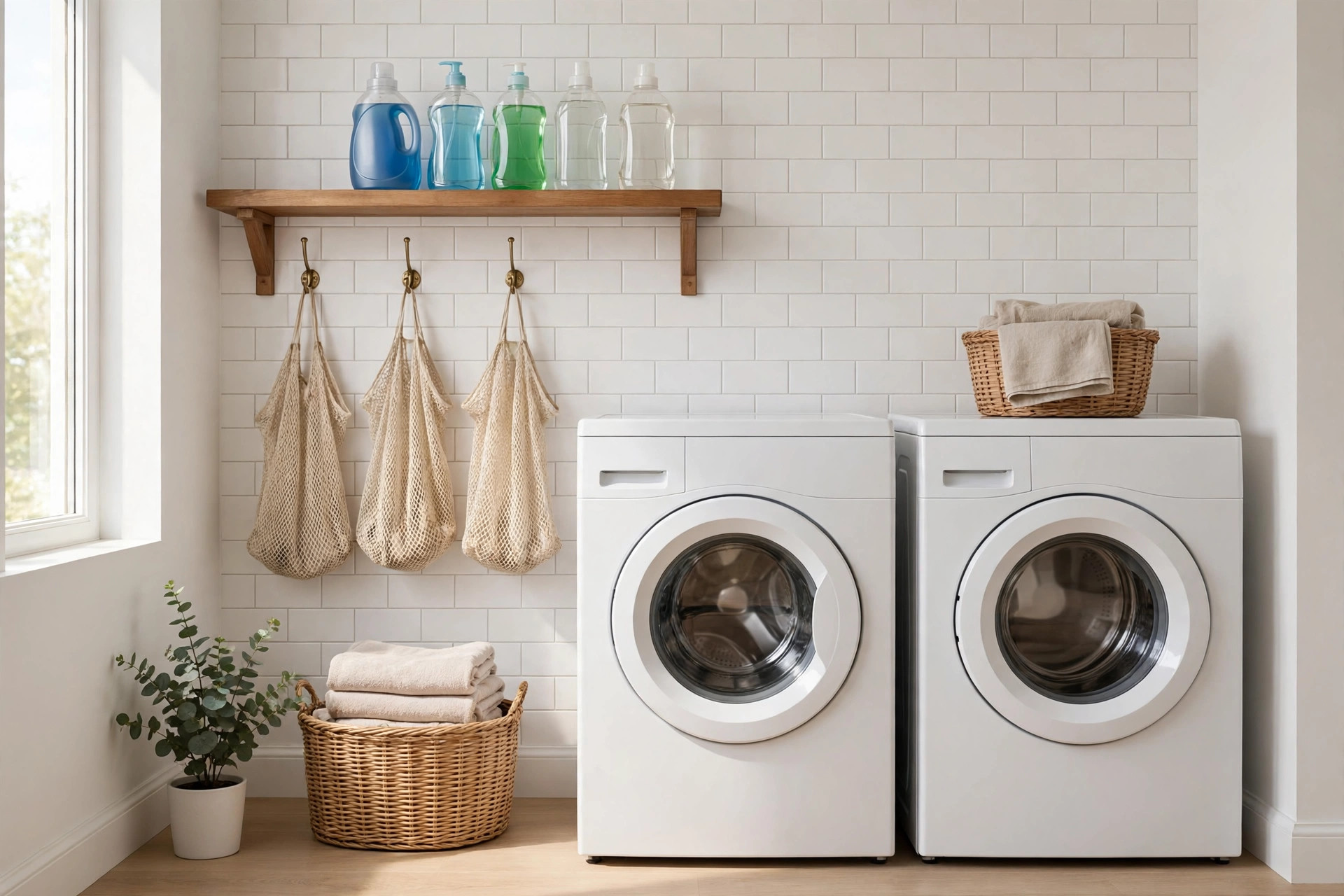
My laundry room used to be the room I hated walking into. The tops of the washer and dryer were buried under detergent bottles, random socks, mail I was too lazy to carry upstairs, and once, a half-eaten granola bar I’m still not proud of. I kept telling myself I’d fix it “someday,” until I realized someday never comes for laundry rooms.
So I gave myself a challenge: one Saturday afternoon, $50, no renovation, no fancy systems. It worked better than I expected — and the biggest win wasn’t even the organization. Let me show you what I did.
First: clear the decks
I took everything off the washer and dryer. Everything. Laid it all on the floor, and it was embarrassing — four half-empty detergent bottles, a lint roller, two phone chargers, a stack of coupons, and enough loose socks to knit a sweater. I made a rule that day and I’ve kept it since: machine tops hold only what’s being used right now.
Then I contained the detergents. A $10 wall-mounted shelf above the machines got the bottles up and off the surfaces. I decanted the giant bulk detergent jug into a smaller container, and bought a labeled pump bottle for liquid detergent for a few dollars — no more glug-glug measuring mess. That $4 pump bottle might be the best money I’ve ever spent on laundry.
The three-bag sorter: the thing that actually changed my life
If you take one idea from this article, make it this one. I bought a three-bag rolling sorter for about $30 — lights, darks, and delicates/towels. Here’s why it matters: when a bag is full, that’s a load. Done. No more Saturday-morning sorting marathons on the bed, no more “is this dark enough to go with the jeans” debates.
Here’s the part I didn’t expect: I do laundry less often now. Before the sorter, I’d let laundry pile up in one giant hamper because sorting it was so annoying that I’d procrastinate until I ran out of socks. Now the sorting happens automatically all week — every shirt lands in the right bag the moment it comes off.
Tight on space? Three labeled hampers, or even three tall laundry bags hung on wall hooks, do the same job. The container doesn’t matter; the pre-sorting does.
My mesh-bag confession: for years I owned mesh bags and never used them because they lived in a drawer. The trick isn’t owning them; it’s hanging them where you can grab them one-handed. I hung two on hooks for delicates and the socks that always lose their partners. Wash the bags with their contents: socks go in dirty and come out still paired.
Going vertical: the walls are free real estate
Laundry rooms usually have more wall than floor, so that’s where I put everything:
- Wall-mounted drying rack ($15–$30): mine folds flat against the wall when I’m not using it. It handles delicates and air-dry items, and it replaced a bulky freestanding rack that used to eat half my floor space.
- Pegboard ($15–$20): I hung the iron, lint roller, stain sticks, and a little sewing kit on hooks I can rearrange whenever I want. It looks great and everything is visible.
- Over-the-door organizer: stain removers, dryer sheets, and spare cleaning supplies live on the inside of the door.
- Magnetic hooks on the side of the washer: this one felt like a cheat code. Metal machines are basically free magnetic storage. I stuck up a small whiteboard for “wash me” notes and a magnetic basket that holds the stain chart.
Taming the small stuff
The lost-sock system that actually works. I keep a small mesh bag labeled “singles” on top of the dryer. When a partner appears three loads later, the reunion happens on its own. Before this, my system was “throw the single sock in a drawer and forget about it,” which is how I ended up with a drawer of 40 orphans I finally threw away in a fit of rage. Never again.
The stain-treatment caddy. Stain remover, an old toothbrush, white cloths, and a printed stain-removal cheat sheet in a small caddy, within arm’s reach of the machines. Stains get treated immediately instead of “later” — and “later” is where clothes go to die.
The folding station. I installed a $20 fold-down wall-mounted table and made a rule: fold straight out of the dryer instead of dumping everything in a basket “to fold later.” Folding takes four minutes when the clothes are warm and flat. It takes forty minutes of resentment when they’ve sat in a basket for three days.
The lint and maintenance corner
I keep dryer maintenance supplies together in one spot: a long dryer-vent brush ($10) for the annual vent cleaning, the vacuum attachments for behind the machines, and — my original trick — I tape the “last cleaned” date on the side of the dryer. Clogged vents are both a fire risk and an energy waster, and that little date is the only reason I actually do it once a year.
The cheap upgrades: light and floor
A $15 stick-on LED light under my shelf transformed a dim laundry closet into a room I don’t mind being in. And a washable runner rug in front of the machines ($20–$30) catches the inevitable drips. Here’s the thing I learned: a room you don’t hate walking into stays organized longer. You maintain rooms you like.
The two-minute reset
Laundry rooms don’t get messy from big events — they decay from abandoned items. The shirt that needed a button. The load left in the washer. The mystery sock. So I end every laundry session with a two-minute reset: machines wiped down, detergent put back on the shelf, floor checked. I also keep a small donate bag in the laundry room: clothes that come out of the dryer shrunken, stained beyond saving, or just never worn go straight in instead of back into the drawer.
Keeping the machines happy (so they last)
Front-load washers: wipe the door gasket after the last load of the day and leave the door ajar — trapped moisture grows mildew that stinks up every load, and it cost me a weekend of vinegar cycles to learn that. Run a hot empty cycle with washer cleaner or two cups of vinegar monthly.
Top-load washers: run a hot cycle with vinegar monthly, and check under the agitator or impeller for trapped items. Socks love to wedge themselves underneath — I once pulled out four.
Dryers: clean the lint filter every single load. A clogged filter is the top cause of long dry times and a genuine fire hazard. Once a year, vacuum behind and under the machines and brush out the vent duct (check that date on the side of the dryer!).
Both machines: keep them level. A rocking washer walks across the floor, bangs loudly, and wears out its suspension years early. Most machines have adjustable feet — a few turns with a wrench fixes it.
No laundry room? No problem
Our last apartment had no laundry room at all — just a stackable unit crammed in a closet. The same principles shrink down: mount a small shelf for detergent beside it, hang the mesh bags, stain kit, and drying rack on the inside of the closet door, and put up a curtain instead of a door to hide it all for almost nothing. The three-bag sorter still works — slim hampers fit in a 2-foot gap. And if you share laundry facilities, a sturdy rolling laundry cart that carries everything in one trip is the single best upgrade you can buy — look for one with a hanging rod for delicates.
The bottom line
Here’s what my $50 Saturday taught me: an organized laundry room isn’t about pretty labels. It’s about removing the friction that makes laundry miserable — no sorting marathons, no lost socks, no hunting for the stain remover while the stain sets. One afternoon, about fifty bucks, and I now do laundry with less dread and fewer loads. I wish I’d done it years earlier.
Leave a Reply