I spent almost a year pretending my basement didn’t smell. I’d light a candle before guests came over, open a window, tell myself it was just “old house smell.” It wasn’t. One day my sister walked in, sniffed, and said, “Your basement smells like a swamp.” That was the day I stopped masking it and actually fixed it.
Here’s what I wish someone had told me from the start: a musty smell is your house telling you something. It’s almost always moisture, and moisture left alone turns into mold, mildew, and real damage. Getting rid of the smell for good means finding the source — not covering it up. I learned every step of this the hard way.
Step 1: Find the source (don’t skip this like I did)
Musty smells concentrate wherever moisture collects. I now do what I call a “sniff walk” through my house twice a year, checking the usual suspects in order:
Basements and crawl spaces. The number-one source. In my case it was the base of a basement wall — the concrete looked fine from across the room, but up close I found that white mineral crust (it’s called efflorescence) and a faintly damp corner behind a storage shelf. That’s where the whole smell was coming from. Sniff along the base of walls; that’s where it hides.
Bathrooms. Our guest bathroom had mildew growing behind the toilet tank, right where the tank meets the wall — pink and black staining along the caulk line. I only found it when I finally got down there with a flashlight. Check around the toilet base, under the sink, and along tub and shower caulk lines.
Kitchens. The drip pan under my fridge had water sitting in it for who-knows-how-long, and the under-sink cabinet had a slow leak that had soaked the particle board shelf. Behind-the-dishwasher leaks are the nightmare scenario — you can’t see them at all until the floor starts to give.
Laundry areas. This one embarrassed me. Our front-load washer had mildew growing in the rubber door gasket because I always left the door closed between loads. Every load of “clean” laundry was coming out smelling like a pond. Also check the dryer vent — a disconnected or clogged vent pumps moist air straight into the house.
Closets on exterior walls. My daughter’s closet on the north wall had mildew on her clothes because we had her dresser pushed flush against the cold wall. Poor air circulation plus a cold wall equals condensation, every time.
Attics. Roof leaks show up as stained wood or damp insulation long before water ever drips through a ceiling.
Step 2: Dry it out (thoroughly, this time)
One hard lesson before the how-to: if you find active water — a leak, seepage, standing water — fix that first. I spent a month scrubbing my basement wall before realizing water was still seeping in during rain. No amount of cleaning beats a moisture source that’s still feeding the smell. Once the source is handled, dry everything thoroughly:
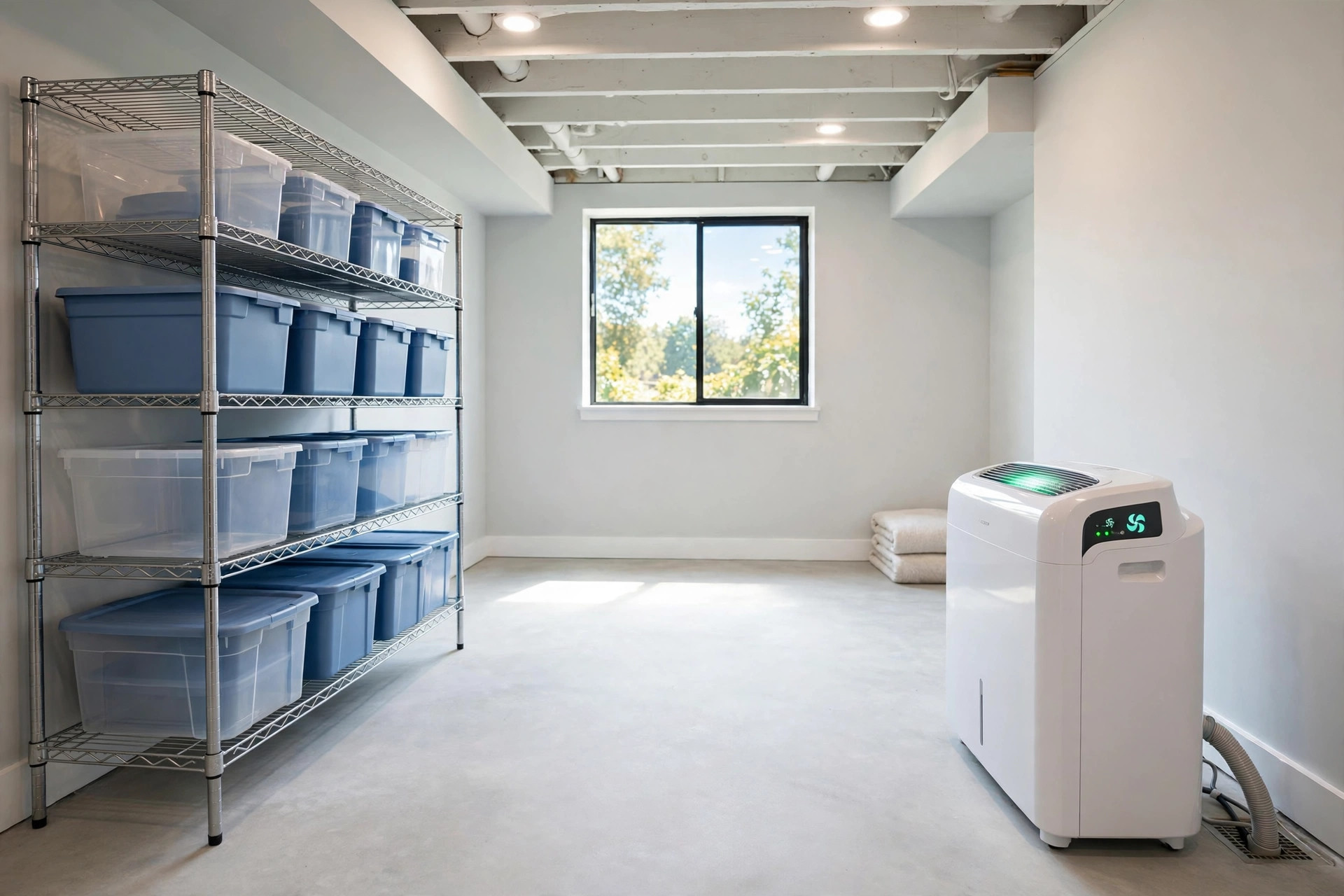
- I bought a dehumidifier for the basement and keep it between 30 and 50 percent humidity — a basic hygrometer cost me under $15.
- I improved airflow: opened doors between rooms, ran a box fan for a few days, and made sure the HVAC vents weren’t blocked by furniture.
- In the bathrooms, everyone runs the exhaust fan during and for 20 minutes after showers. Ours was weak, so I replaced it — and discovered the old one had been venting into the attic instead of outside, which explained a lot.
Step 3: Clean what the moisture touched
For hard surfaces (tile, concrete, sealed wood), I scrubbed with a 50/50 mix of white vinegar and water. Vinegar kills most surface mildew, and for stubborn spots I followed up with a baking-soda paste and some elbow grease. Total cost: a few dollars.
For fabrics — curtains, washable rugs, the clothes from my daughter’s closet — I washed them hot and added a cup of white vinegar to the rinse cycle. The smell came right out. For things I couldn’t wash, a few hours in direct sunlight did real work; sunlight is a genuine mildew killer.
For upholstery and carpet, I sprinkled baking soda generously, left it overnight, and vacuumed it up slowly the next morning.
For books and papers, I isolated the musty ones, aired them out, and wiped the covers with a dry cloth — and did NOT shelve them back in the damp room, because clean doesn’t survive in a damp space. (Yes, I made that mistake first. The books smelled again within two weeks.)
My bleach mistake: when I found mildew on the basement drywall, my first instinct was to nuke it with bleach. Bad move. Bleach kills surface mold on hard, non-porous surfaces, but it doesn’t reach mold roots in porous materials like drywall and wood — and the water in bleach can actually feed what’s underneath. I ended up cutting out and replacing that section of drywall, which is what I should have done in the first place.
Step 4: Know when it’s bigger than DIY
I had to learn where my limits are. Call a professional if you see: mold covering more than about 10 square feet, mold inside your HVAC ducts, mold after any flooding (floodwater carries contaminants), or if anyone in the home has worsening allergies or respiratory symptoms. Also, if you can’t find the moisture source at all — hidden leaks behind walls — that’s plumber or waterproofing-contractor territory, not mine.
Step 5: Keep it from coming back
This is the part that actually matters long-term. My maintenance list now:
- Keep indoor humidity at 30–50% year-round — dehumidifier running in summer, monitoring in winter
- Leave the front-load washer door ajar between loads and wipe the gasket monthly (never again, mildew)
- Run the exhaust fan every time the bathroom or kitchen is used — no exceptions
- Keep furniture a few inches off exterior walls in damp-prone rooms — that air gap prevents the condensation problem that hit my daughter’s closet
- Clean the gutters so water drains away from the foundation, not toward it
- Store basement items off the floor on shelves or pallets
What about air fresheners and odor absorbers?
Here’s my honest take after a year of candle-burning: they’re a supporting act, not the solution. Bowls of baking soda or activated charcoal bags help with residual odor after the source is fixed, and I’ll use them in that phase. But plug-in fresheners and scented candles just layer perfume over the problem. My rule now is the candle test: if the musty smell comes back when the candle burns out, I haven’t found the source yet. That little test would have saved me months.
If you rent: what you can and can’t do
I rented for years before buying, so I know this side too. You can’t tear out drywall — but you’re not powerless. Document everything: photos of stains, moisture, or visible mold, with dates, sent to your landlord in writing. Most states require landlords to address mold and water intrusion, and a paper trail matters if they stall. What you can do yourself: run a small dehumidifier, keep furniture off exterior walls, ventilate the bathroom, and clean surface mildew with vinegar. What you should not do: ignore it because “it’s the landlord’s problem.” Mold doesn’t care whose name is on the deed — it affects your health regardless, so keep escalating in writing until it’s fixed.
Bonus: my musty car smelled like the basement
Same problem, smaller space — cars get musty exactly the same way: moisture plus poor airflow. Mine turned out to be wet floor mats plus a dirty cabin air filter causing that musty AC smell. A new filter was $15 and took me ten minutes to swap. I also left the car in the sun with the windows cracked and sprinkled baking soda on the fabric seats overnight before vacuuming. One warning: don’t ignore a persistent musty AC smell — it can signal mold in the evaporator case, and that’s a shop job.
The bottom line
Musty smell equals moisture, and moisture always has a source. Find it, dry it, clean what it touched, and control humidity going forward. I did it in that order and the smell never came back. Skip straight to the candles, and the smell will outlast every one you own — I know, I tried.
Leave a Reply